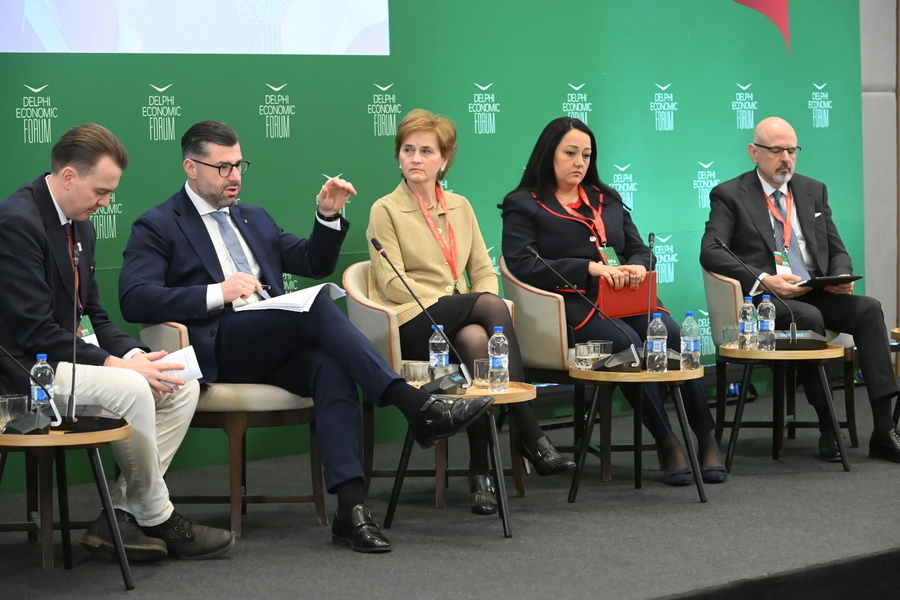
“The euro is a favourable factor for achieving better growth and development for our country. It is up to us to use this tool in a way that will enable us to achieve the levels of economic development we are striving for,” said Deputy Minister Metodi Metodiev during his participation in the Sofia Economic Forum.
In the panel dedicated to Bulgaria's accession to the eurozone and the role of this process in strengthening economic stability, he emphasised that the single European currency is stable and reliable. “It is the second reserve currency in the world, which protects our purchasing power and savings during times of turbulence in the national and global economy. It also reduces borrowing costs. Deeper integration into European structures protects us from external pressure and influence in purely political terms. Today, we have a stronger voice because we are at the heart of Europe, and the heart of Europe is the eurozone,” added Metodiev.
The Deputy Minister of Finance presented in detail the steps taken to introduce the euro in Bulgaria – in political, macroeconomic and technical terms. He emphasised that despite prolonged periods of political instability, our country remained firmly committed to the strategic goal of adopting the euro. “We had a parliamentary majority supporting the adoption of the euro. This was an important political signal to our partners in Europe.”
With regard to macroeconomic aspects, Metodiev pointed out that over the past 15 to 20 years, a reasonable macroeconomic policy has been pursued, which has prevented Bulgaria from experiencing so-called “macroeconomic imbalances”.
“The technical preparations, legislative changes, and logistical aspects of the transition to the euro required a tremendous amount of work on the part of the Bulgarian government and the Bulgarian National Bank. Together, the Ministry of Finance and the BNB drew up a precise action plan – how, when and what to implement in each of the stages we have undertaken to ensure a very smooth transition from the Bulgarian lev to the euro,” Metodiev emphasised.
In response to journalists' questions during the forum, the Deputy Minister announced that no serious shocks or surprises are expected in terms of inflation in Bulgaria this year and next. “What we at the Ministry of Finance predict and can say is that inflation will be within the range of our Autumn macroeconomic forecast, and will even be slightly better, at around 3.5-3.6 per cent.” He added that a slight decrease in inflation, measured by the harmonised index of consumer prices, is also expected next year.