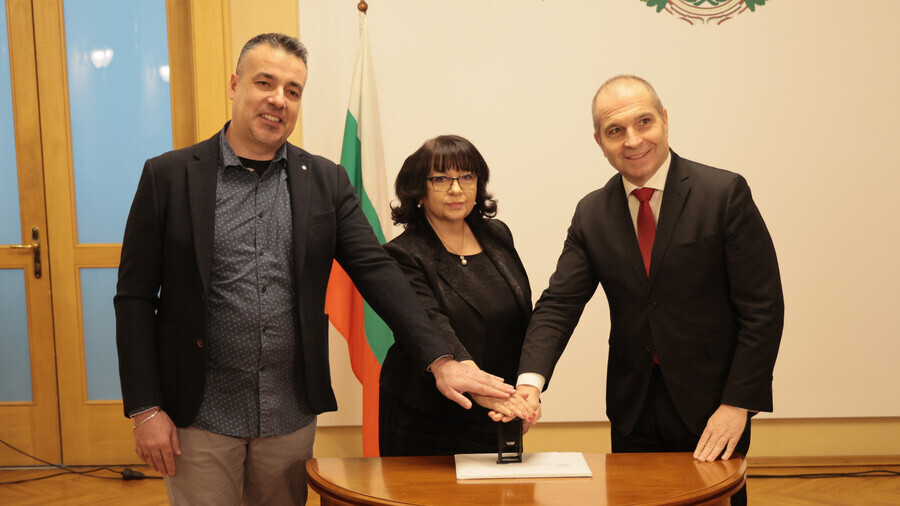
The first philatelic issue for 2026 is dedicated to Bulgaria's accession to the eurozone. This is also the first Bulgarian postage stamp with a denomination in euros – small in size but significant in historical importance, marking a new economic era for our country. This was announced by Deputy Prime Minister and Minister of Transport and Communications Grozdan Karadzhov during the launch of the postal and philatelic issue “Bulgaria in the Eurozone”. The issue was validated by Ministers Grozdan Karadzhov and Temenuzhka Petkova, and the project's artist, Assoc. Prof. Nenko Atanasov.
Deputy Prime Minister Karadzhov explained that this is the second time such a change in the denomination of Bulgarian postage stamps has occurred. “After the Liberation, the first stamps of the young Bulgarian state were printed in centimes and francs, and with the introduction of the Bulgarian gold lev in 1880, stamps began to be printed in levs,” Karadzhov pointed out.
“Over the next 140 years, nearly 6,000 Bulgarian postage stamps were issued in levs, documenting the most important moments in our contemporary history. Today, with this stamp, we are closing an entire historical and collector's cycle,” said the Deputy Prime Minister.
“I wish this brand to cross many borders – just as the images of the Madara Rider, St. Ivan Rilski and Paisii Hilendarski will travel freely across Europe and will be in the wallets of millions of Europeans,” he added. Deputy Prime Minister Karadzhov pointed out that all postage stamps with a denomination in BGN will continue to be sold in the Bulgarian Post network until stocks are exhausted, and their prices will be converted at the official exchange rate to the euro.
Finance Minister Temenuzhka Petkova said that Bulgaria's accession to the eurozone completes the process of our country's full integration into the European Union. “This has been a long-standing dream for generations of Bulgarians, and I am delighted that this government has managed to make it come true and that Bulgaria now occupies its rightful place among the member states of the eurozone. The benefits of Bulgaria's accession to the eurozone are indisputable - first and foremost, it means economic, financial and price stability. It means much more investment, economic growth, higher incomes, easier travel for all Bulgarian citizens abroad, and minimisation of very serious business costs related to currency conversion,” Petkova emphasised.
The finance minister thanked Bulgarian citizens and Bulgarian businesses for ensuring that the adoption of the euro in Bulgaria has been extremely smooth. According to her, there have been no disruptions and all the fears that were trying to be instilled in society have proved completely unfounded. “From now on, we will only reap the benefits of Bulgaria being in the eurozone. All institutions involved in the process of introducing the euro are in place and exercising their powers so that the process is as smooth as possible and complies with the Law on the Introduction of the Euro in the Republic of Bulgaria,” Minister Petkova said.